About


  •  Follow Torrance’s Battle Against Bald at his Bosley hair loss blog, BattleAgainstBald.com, a blog documenting real battles against hair loss, which we take head-on (pun intended) by going through the Bosley hair restoration procedure. Disclosure: all procedures sponsored and performed by Bosley.Torrance

  • Follow Seth Garon’s Battle Against Bald at his Bosley hair loss blog, BattleAgainstBald.com, a blog documenting real battles against hair loss, which we take head-on (pun intended) by going through the Bosley hair restoration procedure. Disclosure: all procedures sponsored and performed by Bosley.Seth

  • Battle Against Bald is a blog documenting real battles against hair loss, which we take head-on (pun intended) by going through the Bosley hair restoration procedure.

Info About Bosley


  • Our procedures were sponsored and performed by Bosley. To learn more about hair restoration, contact Bosley at 800-249-6946 or visit the Bosley website

Hair Restoration Pictures

  • Torrance's Bosley Results
    www.flickr.com
    This is a Flickr badge showing photos in a set called Torrance's Bosley Hair Restoration Procedure Results. Make your own badge here.
  • Seth's Bosley Results
    www.flickr.com
    This is a Flickr badge showing photos in a set called Seth's Bosley Hair Restoration Procedure Results. Make your own badge here.

    Archives

<>


Disclaimer

  • Seth Garon works in Portland, Oregon as Creative Director at Respond2, which is one of Bosley’s marketing agencies. Respond2 is financially compensated for generating and managing the content surrounding this blog. Seth did not pay for his procedure. All the content surrounding the blog is based on Seth’s personal opinion and does not necessarily represent the views of Bosley.
Powered by TypePad

For downtown LA'ers, Bosley consultations can happen in the privacy of your home

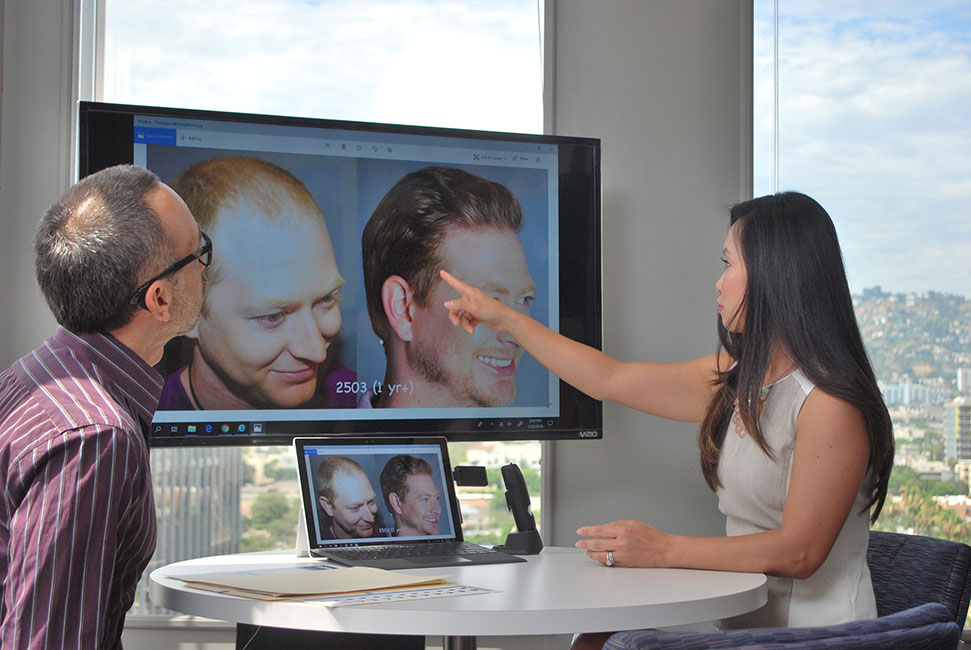
For the downtown-dwelling Los Angelinos, getting a Bosley hair restoration consultation no longer requires a drive out to Beverly Hills. Steve Costomiris, a senior counselor for Bosley for nearly eight years, offers his service right from the comfort of your home, office or other convenient meeting place.

Health01

A consultation would include a discussion of your thinning hair and some possible solutions, including medications, laser therapy and, of course, hair transplantation surgery. If you're living in the downtown LA area, contact Steve for a consultation today by calling (626) 644-3578, or by emailing stevec@bosley.com.

Hair Restoration Results - 9 Months after Bosley Procedure

For those of you wondering if hair restoration works please see the comparison photos below. You'll notice that I don't have the head of young man, but it's clear that I do have more hair. This is old news to dedicated Battle Against Bald readers, but I had 1900 grafts, which is pretty standard for first-time hair transplantation patients. That said, If I were to go through another hair restoration procedure I might actually look as if I were 20 again.

Below are pictures comparing hair growth after my hair transplantation. The first one was taken 36 days after my hair restoration procedure, and the second is of my hairline 270 days after my hair transplantation.

Q: How and can you pick which hair restoration surgeon performs your transplant?

I got an excellent question from a reader who asks: “how did you pick the doctor that did your procedure, or was he picked for you?... how do you find out which doctor is going to give you the best natural look possible?”

First off, there is going to be a determination made based on geography. I went to Dr. Winans largely because he’s in Seattle, which was the closest Bosley clinic to where I lived. So the first thing to do is determine where you can realistically have your hair restoration procedure done.

There will also be considerations based on time frame. Because my hair transplant was sponsored by Bosley, I had to work with the clinic’s schedule – and it all worked out in such a way that Dr. Winans was my doctor. If you have limited flexibility in terms of travel and scheduling, you might have a little less control over which hair transplant surgeon you get to work with. On the other hand, if you can be flexible with your scheduling and are willing to travel, you’ll be more than likely able to work with the doctor of your choice.

For me, I didn’t have any concerns with Dr. Winans because he has a fantastic reputation; also, all Bosley physicians are certified and approved by Bosley – so I had confidence that his standards and skills were excellent. And, of course, I’ve been very happy with the results.

My recommendation, in order to make sure you are comfortable with the doctor you will be seeing, would be as follows: first, determine the physical location(s) where you can get your hair restoration procedure. Next, find out which doctors work out of this location. Finally, you have the power to interview with each doctor, look at examples of their work, and if possible, get referrals from past patients. This may take a little time, but you will be able to rest assured that you have made the best possible choice for yourself.

Good luck with your Battle!

BattleAgainstBald, Bosley and The Big Idea with Donny Deutsch

Believe it or not, I got a last minute opportunity to be on "The Big Idea with Donny Deutsch. Donny's doing a show on (I believe) hair loss and the hair loss business. He was interested in Bosley, and interested in my blog.

So, I got the call last Friday, and got on a plane on Monday. We taped the show at CNBC studios Tuesday morning, and I flew back to the West Coast that night. It was a lot of fun - I like the show, and Mr. Deutsch was a very cordial and smart guy. I'm on a segment with the CEO and Medical Director of Bosley. He also had a few other people there, and while I didn't get to see them tape their segments, I did get to talk to them. I'll be writing some additional entries this week about them - one guy was there to talk about the laser comb (big developments on that front), and the founder of Bald Guyz grooming products was also there.

We don't know exactly when the show is going to air, but it could be tonight (Wednesday, Jan. 31st) on CNBC. Check local listings for times.

Hair Restoration - What will people think?

A common concern for prospective hair restoration patients  is  how the procedure will impact their social relationships with friends, family, and co-workers. In short,  some Battle Against Bald readers are asking:

  1. Will people notice I had a hair restoration surgery?
  2. Will people judge me for having a cosmetic hair transplantation?
  3. Do I have to tell people I had a hair transplant?

I briefly addressed some of these concerns in my Embrace Your Hair Restoration entry, but going into more detail might be helpful. Keep in mind some of this is my personal opinion, influenced by my experience with hair restoration.

Regarding the first question, the reality is that most people will notice something.  Since I've been very open about my restoration from the beginning, people are constantly wanting to look at my head and check my progress.  Other people, who I don't see very often, are starting to comment - but they usually also know that I'd gotten the procedure.  Most people report a gradual increase in comments like "There's something different about you," "Have you lost weight?" etc.

Second, you always run the risk of people judging you for having a hair restoration, but that goes with anything.  Some people are simply judgmental by nature.  And perhaps in your own mind you've thought negatively about someone undergoing a cosmetic procedure.  As I mentioned above, my theory is just embrace it.  Don't be shy or embarrassed about it - be happy.  Let people know.  In my experience, I've received nothing but positive accolades. People are interested in the progress of my transplant and somewhat envious as well. I have yet to have a stranger accuse me of having a  hair transplant, probably because the hair re-growth occurs gradually and my new hair line looks so natural.  I have had a couple of guys give me some negative comments on the blog - but these tend to come from the "militant" branch of the 'Bald is Beautiful' crowd.  Some of these guys are anti-anti-balding - and honestly, I don't criticize them for their decision.  However, it's a very individual choice, and some of us want to do something about our hair loss.  So to summarize - there will probably be very few people who will reaclly judge you, if they do they'll forget about it (probably sooner, rather than later), and - most importantly - if you're happy with your appearance and feel better about yourself, who cares what someone else might think?

Finally, you certainly don't have to tell people you had a hair restoration if you don't want to. However, in my opinion, it doesn't hurt to tell the people close to you.  After all, the folks who know you best will more than likely notice when the transplanted follicles begin to fill your balding head.  Also, the first few days following the procedure you're required to where a special baseball cap, which protects your scalp from the elements. The hat isn't horrible,  mind you, but it's no designer hat either; however, after a few days you're allowed to where the hat of your choice.  And the first two weeks after the surgery, there are some  signs of the procedure on your scalp.  You can deal with this by arranging vacation time after your procedure, etc. - but there will probably be at least a few people who will need to be "in on the secret."

I hope this helps - and keep the hair restoration and hair loss questions coming.

Pain and Discomfort Associated with Hair Restoration

I’ve received a number of questions related to the pain and discomfort a patient can expect to endure during the different stages of a hair transplantation procedure. Here are a few questions asked more recently:

“Is the actual hair restoration surgery painful?”

Was your head sensitive right after the hair transplant? If yes, how long was it sensitive for?”

Does your scalp feel any different now, several month after receiving the hair restoration surgery?”

“Aside from your head, did you experience any illness or other forms of discomfort after the hair transplantation?”

In an effort to effectively answer these questions, I will use what I call the Hair Restoration Surgery Pain and Discomfort Index (HRSPDI, for short). The HRSPDI is broken down into four different stages, which are rated on scale of 1-10 (1 being no discomfort at all, and 10 being an unbearable amount of discomfort). Keep in mind that Hair Restoration experiences vary among patients. Your experience might not be exactly like mine; it could be better or worse. There are a number of variables which might influence your personal experience with a hair restoration procedure.

During the Hair Restoration Procedure – HRSPDI Rating = 2 Basically, I did not feel any pain during the procedure. Granted, this was most likely because I was sedated the entire time. The reason I give this a rating of “2” is because a). After about 7 hours in the chair, I started to get a little stiff (although they always allowed me to get up and stretch, etc.); and b). There is a little discomfort around the suture/donor area. Every few hours the suture would start to get sore, and they would need to re-anaesthetize the length of the donor area. Not great, but overall really not too bad.

First Two Weeks After – HRSPDI Rating = 4.5

These first two weeks are when I experienced the most discomfort. I still did not feel any pain, particularly – although I did experience soreness along the suture line. When you get a hair transplant, you keep the suture in for the first 10 days after the procedure. This was a bit uncomfortable, especially at night when I was trying to sleep. After the suture came out, I felt much more comfortable.

There’s also a lot of itching during this stage – and you can’t touch the parts of your head where the restoration took place. In other words, Bosley tells you not to scratch, rub, or touch any of the new hair grafts for two weeks after the procedure. As you might guess, this is a “double whammy,” since it’s during this stage that there’s a nearly unbearable amount of itching. However, I was able to use a cold compress on my scalp to help curb the itching, which helped a great deal.

During this stage, in addition to not being able to touch any of the new grafts, you’re also not allowed to put your head directly underneath the spray of a shower head. This requires that you wash your hair with the “pouring method,” which I’ve described in earlier posts (see Day 3 After Bosley Hair Restoration, towards the bottom of the page). This isn’t great, either. It’s not painful at all, nor is it uncomfortable – it’s mainly just an inconvenience.

At the end of the first two week period, when I was able to comb my hair, scratch my scalp and shower normally, I experienced a sense of relief and pleasure that I hadn’t known in a long time. At least, not in relation to my hair!

One to Two Months After – HRSPDI Rating = 1.5

After that initial two week period, all I really experienced was continued itchiness. Of course, once you hit this stage you’re able to scratch the top of your head, which naturally makes it much easier.

Also, for probably the first month or so, my scalp had a continued sense of numbness and it felt a little “thick” – almost like it was covered with 1” rubber mat. Once I got into the second month, this feeling went away and my scalp went back to feeling normal.

Today, Nearly Five Months After My Bosley Hair Restoration - HRSPDI Rating = 1

Today, I have no discomfort whatsoever on my scalp or along the suture line.  I’m now simply enjoying watching my hair grow in!

During each of these phases, I experienced varying degrees of anxiety as a result of my impatience. Particularly during the first two weeks, I was frustrated by the inconveniences posed by not being able to touch my scalp. Now, in hindsight, it was a pretty easy ride. And of course, trading two weeks of relative discomfort for a lifetime of hair is an easy exchange to make.

And just to address the last question posed above, I did not experience any other side-effects, illness or other forms of discomfort due to my Bosley procedure.

I hope this is useful to anyone considering Hair Restoration.  Feel free to email me if you have more specific questions.

Q: Does Hair Restoration Surgery Hurt?

A lot of people are curious about whether or not hair restoration surgery is painful.  Personally, I was surprised at how “pain-free” the entire process was. During the surgery itself, there were ample anesthetics (and pain killers) available, so there was very little pain involved. What I experienced was a little discomfort towards the end of the day (caused by being in the chair for several hours). During the procedure there was also some occasional soreness around the suture line where they took the donor tissue – when it would start to hurt, I would ask for more anesthetic in that area. They have to deliver several shots of anesthetic along the suture line – and this was a bit uncomfortable. Of course, once the anesthetic kicked in, it all felt fine.

Truth be told, I was a litlte bit concerned about any sort of pain during my procedure. whether sharp, stinging, cutting or poking.  But there really was no pain.  Occasional discomfort - Yes. Pain - Absolutely not.

After the surgery, there was still no pain. The suture line continued to be a little bit sore and tender. I felt it most at night when trying to go to sleep. Pain relievers (those given to me by the doctor, then just basic Tylenol) took care of the problem, but right when I woke up, and sometimes during the night, I would find the suture area was sore. Once the suture was removed (10 days after the procedure), there was no more soreness – although it continued to be tender for another couple of weeks. Nothing major, I just had to be careful when scratching the back of my head or combing my hair.

Which leads me to the main sensation I’ve had throughout the entire process – itching. Really, if I had to choose one word that describes what you feel during and after a hair restoration surgery, it’s itching. The few days immediately following the procedure were the worst – but I was able to put a cold compress on my head, which helped a lot. Then, I found the itchiness subsided for a while, until the follicles began to really take root and the new hair started to grow. Now I’m feeling itchiness as more and more new hair is sprouting on my scalp – although it’s much milder than what I experienced after the surgery. And, of course, I can touch the top of my head and scratch my scalp – actions I couldn’t take immediately after the procedure. I still try to be gentle, as I don’t want to damage any of the new “vellus” hairs as they grow in.

So in my experience, I have to say there was a surprising lack of pain involved. But if you’re considering hair restoration, be prepared for an itchy scalp.

Here's a picture of myself during the Bosley procedure - watching a movie and occasionally dosing off.

Q: What are the costs of a Bosley Hair Transplantation procedure? #2

Last week I wrote an entry detailing the financial Cost of a Bosley Hair Transplantation.  There’s no doubt that Bosley is an investment, and for some of us a major financial decision.

While doing my research, I looked at some of the other hair restoration options and the cost implications.  For example, if I ordered Scalpmed from their website, it would cost me $178 for 6 months. That’s $10,680 for 30 years of product – which is about the same price for a Bosley procedure, except the payments are spread out over 30 years.  However, I would have to apply it twice a day, every day, for the rest of my life – or else I would lose all the hair that it may have helped me grow. Rogaine is potentially a little bit cheaper, but it’s the same deal. I tried Rogaine before, and hated it – it dried out my scalp, it burned, and I didn’t like having to apply it twice a day.  Plus, if I ever decided to stop using it (or for some reason they were to go out of business), the money would be wasted and the hair would be gone.

The other option is medication. Propecia is fairly expensive – usually about $60 per month.  There’s a newer option, Proscar, which is quite a bit less expensive (about $150 a year).  Bosley often recommends that their clients use one of these medications as a way to keep the hair they have, and potentially grow some new hair in the “back” or “crown” area of the head (new hair growth is a rare, but possible, bonus of Propecia). Again, I can only speak for myself – and while I’m not opposed to using one of these medications, for now I’m resistant because I want to have children in the near future, and have some fears about the sexual side effects.  They say that you can always just stop taking the medication and the side effects go away, but I’d rather not take the chance of messing with my “genetic material,” as it were, until I’m done with it.

Then, of course, there’s the toupee/hair weave option.  I’ve actually heard that weaves can look good.  A female friend of mine once dated a guy who had been to Hair Club for Men, and she didn’t even know it until he told her.  However, as I understand it you need to go in for regular “maintenance” visits (about 4 times a year).  And there’s an annual “reconditioning” – which as far as I can tell means that you’ve got to get a new weave put in.  This is certainly how it works for women, so I’m assuming it’s the same for men.  Actually, if anyone out there can tell me more about this process, I’d welcome the information.  The fact that it’s hard to get a straight answer from these folks without committing to the process seems to me like a bad sign, but I don’t have all the info.  As for toupees, my level of hair loss didn’t warrant that.  And personally this is not something I would consider.

Now, I want to make clear that I support all of my brothers and sisters as they Battle Against Bald.  I say kudos to those that embrace the “Bald Is Beautiful” idea.  As I said before, it really comes down to your personal goals and preferences.  For me, a one-time permanent solution was the best choice.

Q: What are the costs of a Bosley Hair Transplantation Procedure?

A lot of people are curious about the cost of a Bosley hair transplantation procedure.  Naturally, this is one of the deciding factors for many men and women in terms of whether or not to move forward with a hair restoration surgery.

Most places that do follicular unit transplantation procedures (like Bosley) charge on a per-follicle basis; and generally, the higher the number of follicles the lower the “per-follicle” charge.  So, for instance, if you choose to do 1600 follicular transplants instead of 800, it doesn’t double the cost.

If your situation only requires a low (usually under 1,000) number of hair transplants to cover your bald spot, the cost is $9.50 per follicle. At the other end of the scale, you pay about $5.50 per follicle if you need a lot of transplants. Bosley also offers financing, with a number of different terms. There are a lot of options, so I’ll give you some examples: If you get, say, 600 grafts, you’ll pay $9.50 per graft. The cost of the procedure is $5,700. On a 60-month term, the monthly payment is around $118. If you double that, and get 1200 grafts, you’ll pay $8.00 a graft. The total cost of the procedure would be $9,600, and the monthly payment on a 60-month term would be about $199. At the other end of the spectrum, let’s say you get 3000 grafts (this will likely take more than one sitting, by the way). You’ll pay $5.50 a graft, and the total cost would be $16,500. The lowest monthly payment on this amount would be approximately $342. You could also go for a shorter term on the financing, in which case your payments go up (of course).

When I first learned of the costs associate with hair transplantation, I was a bit surprised.  However, having gone through the procedure myself, I feel that I understand the value. I had 1900 grafts done during my procedure, which took an entire day. During that day, I had Dr. Winans and an entire team of nurses and technicians dedicated to the success of my hair restortion. In totall, there were 7 or 8 trained professionals devoted to my procedure for an entire day. Also, all of the anesthetic and pain medications are included – as are a number of post-operative hair and scalp care products. So overall, I felt like I understood why the price was somewhat high.

The other side of the coin, of course, is – how much would you pay to have a full head of hair for the rest of your life?

It all depends on your perspective, and your own personal desire regarding your hair and hair restoration. The good news is, now you have options if you don’t want to be bald!

Online Hair Loss Resources

Have you heard about the popular online Q&A forums Yahoo and Google Answers? If not, you're missing out on lots of good information about hair loss, hair transplantation and just about everything else.

On Google Answers , you ask a question and a professional researcher will answer it for a small fee ($2 - $200). However, most times you don't need to even ask a question as a lot of questions have already been asked. There are some random questions, such as:

But then there are also some very useful questions and answers related to hair loss and hair transplantation:

Yahoo Answers is a little different, as peers actually answer their peers questions, at no charge.

Here is an example of what people are asking:

Or when looking for first hand hair transplantation experiences, just go to battleagainstbald.com and follow My Bosley Procedure category where you can learn about my Bosley hair transplantation experience, beginning to now.

Take the answers on Yahoo and Google Answers with a grain of salt, as there definitely are some very unqualified people weighing in. However, as you are out there exploring your options, I think that both of these sites can be valuable resources about hair loss.

Subscribe

Enter your email address:


Read Our Posts Via RSS


Battle Mail
Our Monthly Newsletter

* required


*


Powered by VerticalResponse

Talk To Me